
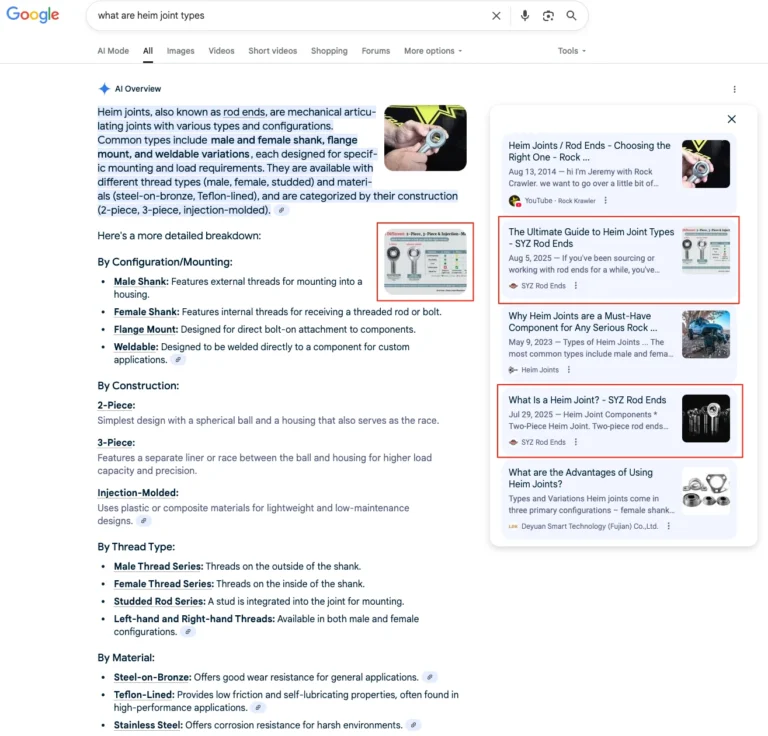
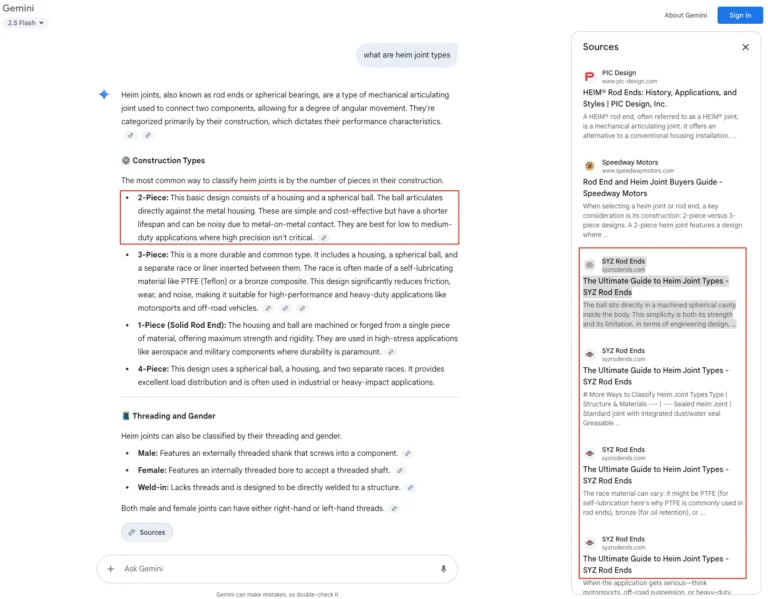
I entered the question “What are heim joint types?” into both Google Search and Gemini, and received two sets of results:
Google Search AI Overview
Gemini
I also asked the same question in ChatGPT and requested some recommended articles, and the results were as follows:
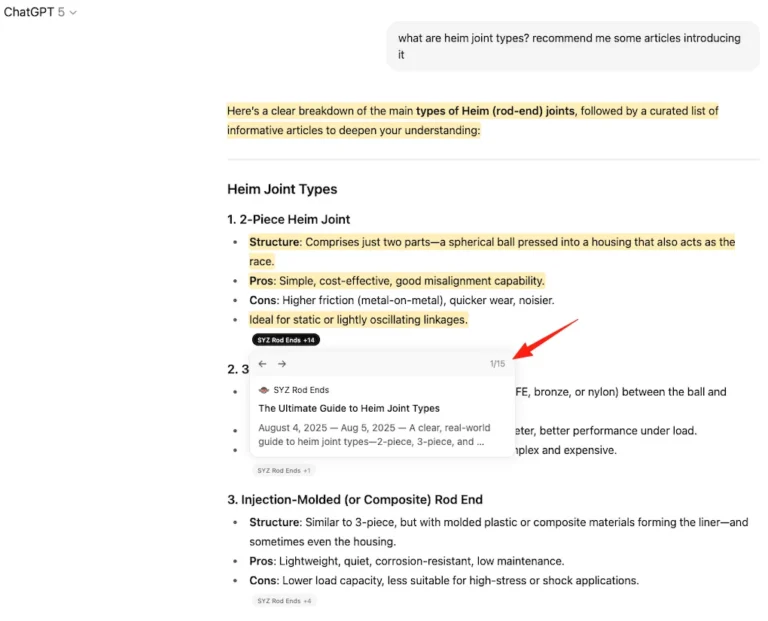
Yes, the content highlighted in red boxes and arrows is my own writing. And, approximately 7 days after publication, it started appearing in the Google Search AI Overview citations.
In traditional search mode, it would be nearly impossible for a brand-new article to make it to the first page within such a short time, let alone appear at the very top of search results with minimal scrolling.
So, does this mean my article is ranked #1 on Google Search?
The answer is: Not really!
According to a Semrush study, nearly 90% of ChatGPT citations actually come from pages ranked beyond position 21 on Google.
This means: even if your page isn’t on Google’s first page, you still have the chance to appear in the top three AI search citations.
This is what we call LLM Seeding Optimization, and in the SEO industry, it’s more commonly referred to as GEO (Generative Engine Optimization).
I think this term may sound a bit “awkward,” but it’s certainly quite fitting.
What is GEO?
GEO (Generative Engine Optimization) refers to an optimization strategy aimed at generative AI search engines.
Unlike traditional SEO, which relies on rankings in Google or Bing, GEO focuses on making your content more likely to be cited and recommended by large language models like ChatGPT, Gemini, and Perplexity.
In other words:
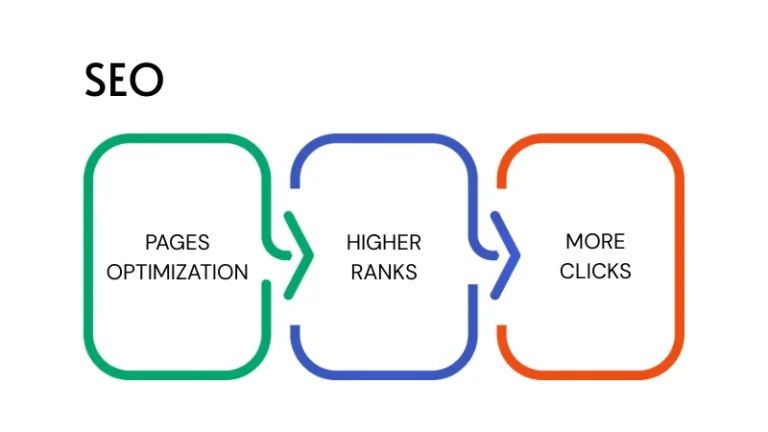
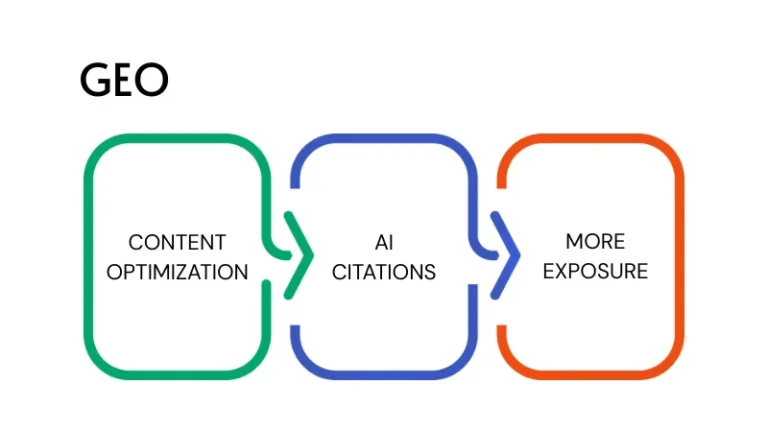
- SEO optimizes webpages → ranks higher → gets clicks
- GEO optimizes content → gets cited in AI answers → gains brand exposure
| Aspect | Traditional SEO | GEO (Generative Engine Optimization) |
|---|---|---|
| Optimization Focus | Google, Bing, and other search engines | ChatGPT, Gemini, Perplexity, and other AI search engines |
| Core Objective | Improve rankings, gain click traffic | Gain mentions and citations in AI-generated answers |
| Main Tactics | Keyword placement, backlink building, content updates | Structured content (FAQ, comparison tables, rankings), AI-friendly formats |
| Content Focus | Write for human readers, while keeping search engine rules in mind | Write for human readers, while ensuring content is AI-friendly and easily crawled |
| Success Metrics | Rankings (SERP position), organic traffic, conversions | Frequency of appearance in AI answers, brand search volume, direct traffic |
| Time Frame | New content may take weeks or months to show results | New content can be cited by AI answers in days |
| Value Focus | Driving traffic (click → website) | Building brand recognition (exposure → brand trust) |
SEO = Competing for Clicks, GEO = Competing for Citations
SEO is about competing with search engines for rankings, while GEO is about competing with AI’s response logic for citations.
Why Do You Need to Do GEO?
Because traditional organic traffic is being eaten up by large language models (LLMs)!
Think back to two years ago: What kind of search engine did you use most? What do you use now? ChatGPT? Gemini? Perplexity? Or something else?
According to a Semrush study (published in July 2025), by the beginning of 2028, AI search traffic is expected to surpass traditional search.
According to conductor’s study (also published in July 2025), out of the 118 million keywords analyzed in July 2025, 18%—about 2,500 keywords—showed AI Overview (AI-generated summaries) in their search results.
Based on Datos market data, as of June 2025, approximately 5.6% of desktop browser search traffic in the U.S. is being directed to AI models like ChatGPT or Perplexity, which is nearly double the growth compared to the same time in 2024 (2.48%).
According to Advanced Web Ranking’s monitoring, AI Overview (AI-generated summaries) now appears in over 50% of all search results, a significant increase compared to 25% in August 2024.
Thus, there’s no further explanation needed for why GEO is essential.
3 Major Advantages of GEO
1. Visibility No Longer Relies on Clicks
Nowadays, users often do not need to click through to a webpage to get the information they need. They can directly find it in Google AI Overview or other large language model (LLM) responses.
Once your brand is mentioned in these answers, even without traffic being directed to your site, it can still remain in the user’s mind.
2. Natural Authority Building
When an LLM mentions your brand alongside industry leaders, you gain additional credibility.
Even emerging or niche brands can leverage this “parallel citation” to quickly build industry endorsement and recognition.
3. Breaking Down Competitive Barriers
In traditional search, only content ranked highly gets attention.
However, in the logic of LLMs, the system is more likely to choose the “optimal answer“ rather than just looking at who ranks on the first page.
How to Implement GEO?
Before diving into GEO optimization strategies, it’s important to emphasize that traditional SEO techniques are still essential. Only by establishing a solid foundation with SEO can GEO truly maximize its value.
The core of GEO lies in content optimization. Large language models (LLMs), such as ChatGPT, Gemini, and Perplexity, rely heavily on the structure, authority, and citability of content when generating answers.
Therefore, the following optimization techniques will focus mainly on content creation, rather than diving into the technical aspects of traditional SEO.
Step 1: Find Topics to Create Content Around
When selecting topics, I typically use two approaches:
(1) Starting from your own business
Extend your product range and create content from angles like 5W1H (question-based), Applications, Buyer’s Guide, etc.
Advantages: Over time, you can gradually cover a very comprehensive range of topics.
Disadvantages: There’s a risk of becoming too inward-focused, limited to what you’re already familiar with.
(2) Finding topics others are searching for
Common methods include tools like Google’s People Also Ask, AnswerThePublic, Deap Market, Reddit, and Quora.
These tools help you find real user search queries. Simply choose a seed keyword, and you can branch out into numerous related topics.
Step 2: Search in AI
No, it’s not about writing directly. Instead, start by looking at how other articles are written and cited in AI.
- What content is highlighted?
- What unique phrasing or style is used?
- What does the article structure look like?
By observing these characteristics, you can assess how to do it better.
I recommend taking note of these articles, organizing them into a reference document, and then using ChatGPT for summarization and analysis.
Step 3: Do Secondary Creation
After reviewing the materials that ChatGPT has organized and analyzed for me, the next step is secondary creation.
There are many AI rewriting tools on the market. Should we use them? Personally, I do not recommend them.
Currently, AI still lacks true original creation capabilities. What you see as “deep thinking” is actually an imitation of thought, where the output is just a reorganization of existing data.
If you rely solely on rewriting tools, your content essentially remains a copy of existing material, which cannot be cited again.
So, how do we perform effective secondary creation? Here are three key strategies:
(1) Introduce Different Perspectives
If you are familiar with your business or product (this is a must), try to present a new perspective that contrasts with the existing answers and back it up with relevant data, case studies, or theories.
For example: If AI highlights the value-for-money aspect of a product, you can add another angle, such as its durability in extreme conditions, and support it with experimental results or customer cases. This makes your content differentiated and more credible.
(2) Add Additional Content
Based on the AI overview or existing citations, further expand the content to make the answer more comprehensive.
For example: If AI simply states that Product A is better for beginners, you can elaborate on why it’s better (price, ease of use, after-sales support) and enrich the content with data or real-world use cases. This makes the information more complete and closer to user needs.
These two steps are not difficult to implement. As long as you’re familiar with your own business or product, you can always find unique viewpoints and more detailed supplemental content.
But what if you don’t fully understand your business or product?
In that case, try exploring industry data, YouTube, social media, Reddit, and other platforms to gain real insights and transform them into your own content.
(3) Optimize the Structure
If you have neither a new viewpoint nor additional content to supplement, at least focus on optimizing the structure.
LLM data sources are similar, so if your content’s structure is clearer and more logically sound, it may be prioritized for citation.
So, “reworking old content” is a skill in itself!
With these basic strategies for secondary creation in mind, the next step is to optimize the presentation of the article to make it more in line with LLM preferences.
Step 4: Make LLM Like Your Content
(1) Straightforward and Promotional Titles
Your titles need to be clear and direct, using question-based (How, What, Why), list-based (Top, Best, Ultimate, Complete Guide), or action-driven words.
Not Recommended Title: “Some thoughts about XXX products”
Recommended Title: “The Complete Guide to XXX Products”
(2) Pointed Meta Description and Excerpt
The Meta Description and Excerpt serve as the “condensed conclusion” of your article. While in traditional search, they impact click-through rates, in AI search, they might be directly extracted by LLM and used as part of the citation.
Optimization Tips:
- Start with a clear and direct answer or statement.
- Keep it between 120–160 words to avoid redundancy.
- Include core keywords + a bit of promotional touch (e.g., “Best guide to…”, “Learn how to…”).
- Let users understand the article’s value without needing to click.
Not Recommended Example: “In this article, we will introduce some information about…”
Recommended Example: “Discover the 5 main Heim joint types, their pros & cons, and how to choose the best option for automotive and industrial use.”
(3) Structured Content
Your entire article should have a clear table of contents.
- Use structured headings (H1–H4) where each section focuses on one topic.
- Include bullet points, tables, and pro vs. con comparisons to summarize key points.
- At the beginning of each paragraph, add a sentence that summarizes the point (LLM loves short, direct summarizing statements).
Tip: If you closely examine how AI search outputs are structured, you’ll notice a pattern in the way they organize information.
(4) User-Friendly Words and Tone
Use easy-to-read words and only incorporate highly technical terms when necessary.
Professional content can be placed in the latter part of the article or explained through a glossary or terminology section.
Remember, the article is ultimately for people, and if it’s overloaded with jargon, most readers will simply leave, resulting in a high bounce rate. This, in turn, sends a signal to Google that:
The article is not interesting to users, and therefore not recommended.
As a result, this can also negatively affect how Google Search’s AI evaluates your content.
(5) Authentic Reviews
First-person product reviews are one of the most favored signals by LLMs.
You can gather real reviews of your product from platforms like Amazon, Reddit, Quora, and industry-specific forums, and then recreate them into a first-person review.
(6) Comparison Tables
In longer sections, where you’ve divided the content into multiple subheadings, you can place a summary comparison table at the end.
This not only makes it easier for readers to browse, but LLMs also love this format.
You can include phrases like “Best for XXX” in the table, which are easy for large language models to quote when answering questions.
(7) FAQ-Style Q&A
Do you know why FAQ-style content is more likely to be cited by LLMs?
During their training phase, LLMs are exposed to a massive amount of Q&A format data (from platforms like Quora, Reddit, and FAQ webpages).
This question-and-answer structure aligns perfectly with the LLM learning logic, making it easy for LLMs to extract and generate answers.
Similarly, in RAG (Retrieval-Augmented Generation) applications, FAQs are often stored in a vector database as Q&A pairs to allow models to quickly retrieve relevant content.
Practical Suggestions:
- Find questions from People Also Ask, AnswerThePublic, and customer support issues.
- For each question, give a direct answer first, then elaborate.
- Use Schema Tag (FAQPage) to help AI better understand your content.
(8) Pros & Cons Format Content
Pros & Cons—advantages vs. disadvantages—are favored by LLMs due to their inherent binary structure, making them perfect for quick summary extraction.

Both users and AI will see this as an objective evaluation, rather than a one-sided recommendation.
According to a Semrush study, many AI citation snippets are sourced from product reviews that include a Pros & Cons list.
(9) External Authority Citations
Including references to authoritative research, industry standards, or statistical data within your content—and providing sources and external links—can greatly enhance the credibility of your article.
LLMs tend to favor answers that come with references and data.
(10) Image Content
Make sure to use images in appropriate sections of the article, and optimize them properly:
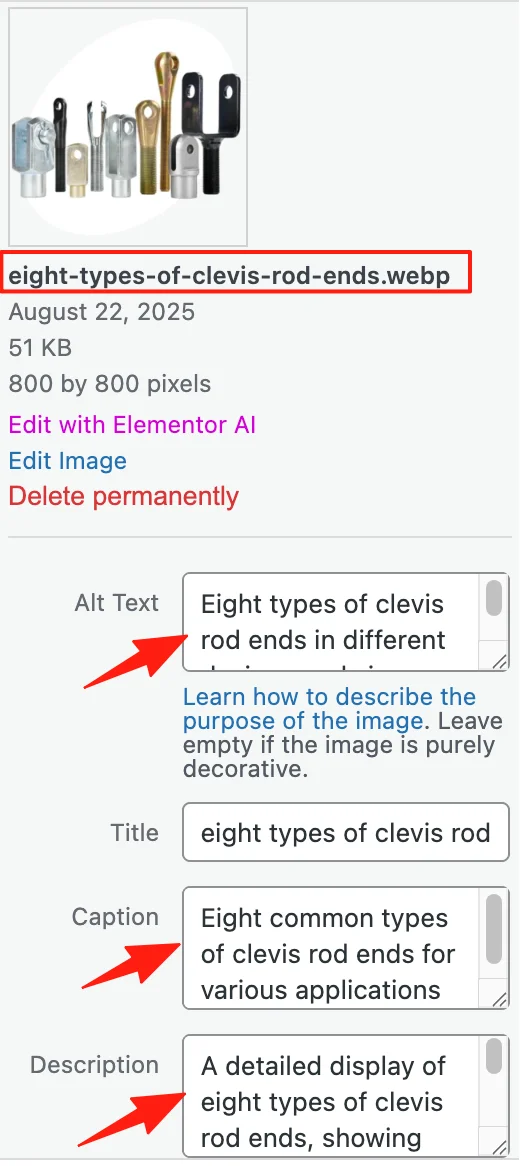
File name, Alt Text, Caption, and Description should all clearly describe the image content.
In the body of the text, you can reference images by stating, “As shown in the image below…”
Resize images appropriately, and convert them to WebP format if possible.
Use original or modified images, and consider using AI-generated composite images if necessary.
(11) Adjusting Styles
Long texts with no style changes can easily cause readers to lose focus, and the same goes for AI.
To improve readability, consider making stylistic adjustments to your paragraphs.
For example, you could:
- Add background shading to highlight important sections.
- Bold or underline key points in a sentence.
In short, make your content visually dynamic to prevent readers from experiencing visual fatigue after reading for just a minute.
(12) Setting Schema Tags
Create complete Schema Tags for each article to help LLMs understand your content more accurately.
If you’re using WordPress, I highly recommend the All in One SEO plugin, which provides excellent value for money.
It offers a rich set of Schema Tag presets and fully supports Custom Schema Tags.
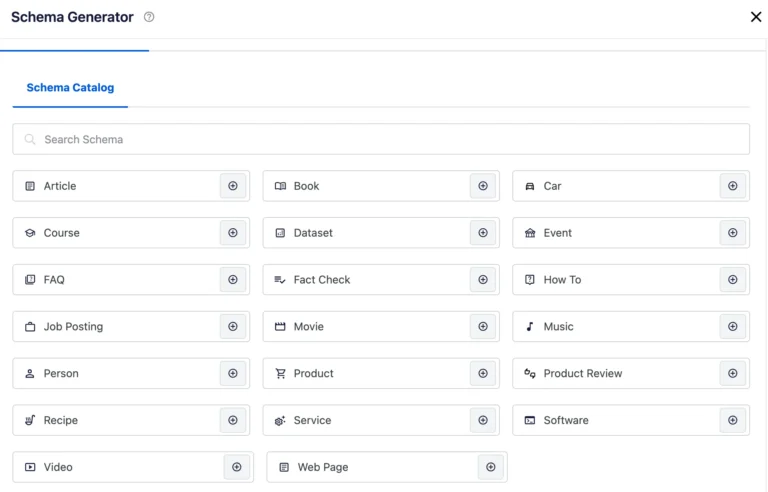
If you want to learn how to set them up, check out my YouTube tutorial on Schema Tag Setup.
(13) Multi-Platform Distribution and Citation Seeding
Don’t just publish your article on your own website—also share it on AI-high-frequency citation platforms.
LLMs like to pull content from these sources:
- Third-party platforms: Medium, Substack, LinkedIn articles
- Authoritative industry media: Guest posts, expert quotes, and inclusion in “Top Lists” to increase exposure
- User-generated content platforms: Reddit (most cited by LLMs), Quora, GitHub discussions
- Niche industry forums & public FB groups
- Microsites: For example, IKEA’s secondary site lifeathome.ikea.com
- Review and comparison platforms: G2, Capterra, TrustRadius
- Social media: Twitter/X (long posts), YouTube (with descriptions and subtitles), Pinterest, Instagram (with alt text and hashtags)
How to distribute?
Instead of directly reposting the original article, break it down into core points + short answers, and share them on these platforms, adding a link to your original content or brand name.
(14) Multi-Modal Content (Text + Video + Audio)
Google, Perplexity, and other LLMs also pull data from video subtitles and blog notes, so if your article is paired with video or audio, it adds extra entry points for citation.
(15) Multi-Language Coverage
If your business is global, publishing the same high-quality content in multiple languages can increase the likelihood of being cited by LLMs in different markets.
I recommend a WordPress multi-language plugin: TranslatePress
If you are interested in the detailed practical work of the steps above, check another blog about ChatGPT writing.
The Future of SEO is GEO
From having an article appear in Google AI Mode’s citations just 7 days after publication to data showing that AI search traffic will surpass traditional search by 2028, the facts are clear:
The rules of the SEO game are being rewritten.
GEO (Generative Engine Optimization) is not a replacement for traditional SEO, but rather its upgrade and extension.
SEO gives your content the opportunity to be discovered by search engines. GEO gives your content the chance to become part of AI-generated answers, directly placing it in the user’s field of view.
In this zero-click AI search era, users may not visit your website, but they will see your brand in the AI’s answers. Over time, this citation will turn into brand recognition, trust, and eventually solidify as direct searches and customer relationships.
If the past decade was about competing for clicks through SEO, the next decade will be about competing for citations through GEO.