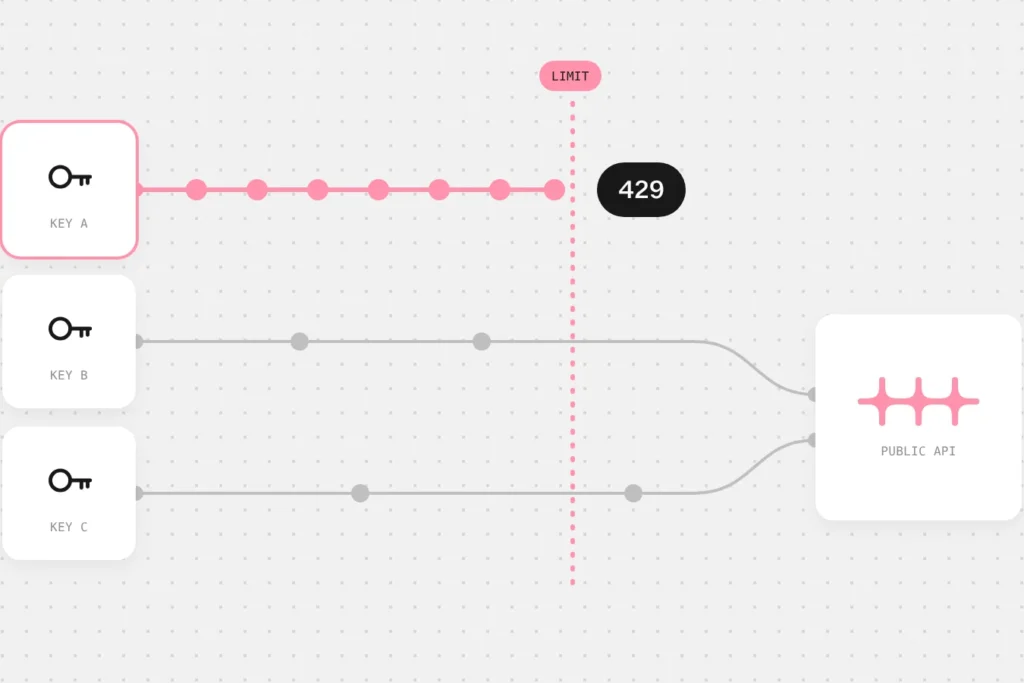
n8n now caps public API requests per key and returns 429 headers with retry timing, plus idempotency keys for safe retries. Teams sharing one instance stop starving each other's integrations.
n8n has added rate limits to its public API, capping how many requests a single API key can make against an instance. The limits come with 429 responses that carry headers telling clients when to retry, and idempotency keys so a retried request doesn’t get processed twice. The change is aimed at keeping every team on a shared instance running when one of them gets greedy with API calls.
What actually changed
The mechanics are straightforward. Requests are counted per API key rather than per instance or per user, so the ceiling applies to each credential separately. When a client crosses its limit, the API answers with HTTP 429 instead of processing the call, and the response headers include the information a client needs to figure out when to come back. That turns rate limiting from a silent failure mode into something a well-built integration can handle on its own.
The idempotency keys matter as much as the limit itself. Retrying a request that timed out or got throttled is the obvious client-side response, but blind retries on write operations are how you end up with duplicate records, double-sent messages, or two of the same workflow firing. Idempotency keys let a client resend the same request and have the server recognize it as the same operation rather than a new one.
There’s no old-versus-new table to draw here, because the announcement doesn’t describe a prior per-key limit that this replaces. The practical comparison is between an instance with no per-key ceiling and one with it: before, a single runaway script or a misconfigured integration could consume whatever capacity the instance had; now each key has its own budget.
Why per-key limits are the right unit for shared instances
n8n’s whole pitch is that teams run their own automation server, and in most real deployments that server is shared. Marketing has workflows pulling ad platform data. Ops has syncs against internal systems. Someone in finance built a nightly export. They all authenticate against the same instance, often with separate API keys issued to separate people or separate tools.
Without per-key limits, the failure mode is ugly and hard to diagnose. One integration with a retry loop that doesn’t back off can saturate the instance, and everyone else’s workflows start timing out for reasons that have nothing to do with their own code. The person debugging it is usually not the person who caused it. Scoping the limit to the key means the blast radius of a badly behaved client is that client.
This is also a governance feature disguised as a technical one. Once limits are per key, API keys become something worth issuing carefully and revoking when a contractor leaves or a project winds down. Teams that have been passing around a single shared key because it was easier now have a concrete reason to stop.
The 429 headers are the part developers should actually build against
A rate limit without retry guidance just moves the problem. Clients hammer the endpoint, get rejected, and hammer it again. The retry headers change the contract: the server says when to come back, and a client that respects that stays inside its budget without guesswork or hardcoded sleep timers.
If you maintain anything that calls the n8n public API, the work now is to handle 429 explicitly rather than letting it bubble up as a generic error. That means reading the retry timing from the response instead of picking an arbitrary backoff, and attaching an idempotency key to any write request that might get retried. Both are small changes. Skipping them means your integration will work fine in testing and start failing intermittently the first time it shares an instance with a busy neighbor.
The idempotency piece deserves more attention than it usually gets. Most teams add retry logic long before they add deduplication, and the gap only shows up in production as duplicate rows or repeated notifications that are painful to trace back to their cause. Having the server-side mechanism available is the easy half; using it on every non-read request is the half that takes discipline.
What to watch next
The announcement doesn’t specify the actual limit values, whether they’re configurable per instance, or how they interact with self-hosted deployments where the operator controls the server. Those are the questions that determine how much this changes day-to-day operations. A generous default that operators can tune is a different product than a fixed ceiling imposed from above.
Watch for how n8n documents the retry headers and whether client libraries or the built-in HTTP request node handle 429 and idempotency automatically. If the platform’s own tooling respects the limits out of the box, most users will never think about this. If it doesn’t, every team building against the public API inherits the same retry-handling homework. The rate limit itself is a sensible guardrail. Whether it feels invisible or becomes a support burden depends entirely on what ships around it.
Source: blog.n8n.io