This is a practical review of the account, Apple ID, device, payment, language, timezone, and ISP-IP setup I use to keep Claude Code stable.
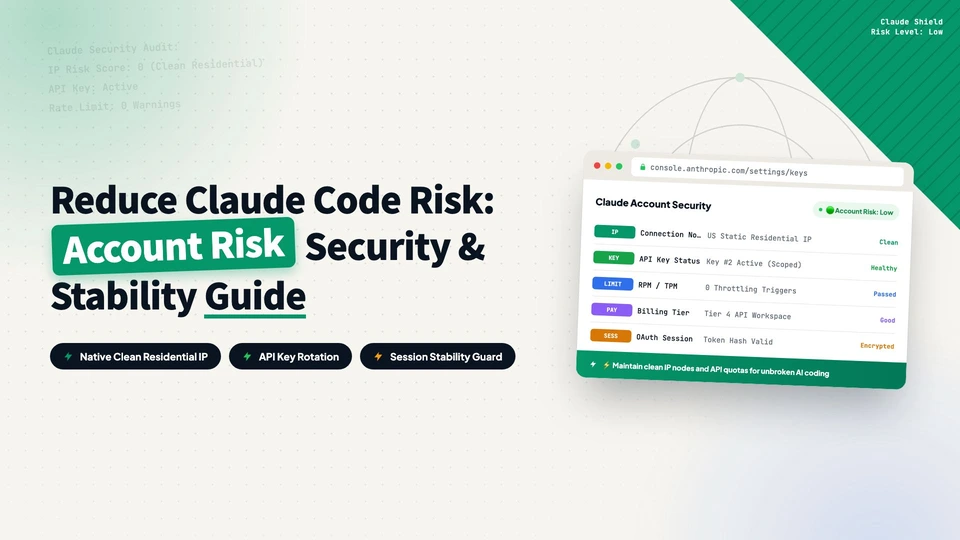
The boundary: this is not a guarantee
This is not a guide to bypass platform enforcement, fake identity, or violate service terms. Account stability depends on platform rules, account status, payment history, device environment, and network behavior. No single setting can guarantee that an account will never run into problems.
What I can share is my own operating setup. My Claude Code account has remained stable during long-term use. Looking back, the important part was not one special trick. It was keeping account region, payment method, devices, language, timezone, and network behavior consistent over time.
My actual account setup
My Claude-related environment is built around one consistent U.S.-region setup:
- I use a U.S. Apple Account.
- I log into that Apple Account on a U.S. iPhone.
- I do not put any non-U.S. SIM card in that iPhone, so the cellular environment does not contradict the account region.
- I add balance with Apple Gift Cards and use that Apple Account balance for related payments or subscriptions.
- The iPhone region is set to the United States.
- The iPhone timezone is set to a U.S. timezone.
- The preferred language is English.
- Location services are turned off.
The point is not simply “use the United States.” The point is that the account profile, device region, language, timezone, and payment path should not contradict one another. If an account looks like it belongs to one region, but the device language, payment source, login region, and network location keep changing, the overall pattern becomes unstable.
The MacBook follows the same environment
Claude Code is used most often on my MacBook, so I keep the computer aligned with the phone instead of treating it as a separate environment:
- The MacBook is logged into the same U.S. Apple Account.
- macOS region is set to the United States.
- macOS timezone is set to a U.S. timezone.
- The preferred system language is English.
- Claude, the browser, and Claude Code are used mostly on the same MacBook over time.
My view is that platforms do not only evaluate one login. They see a pattern over time. If the phone, laptop, payment method, language, and network are consistent, the account profile is easier to understand. If the same account appears to behave like a different person every few days, it is more likely to trigger verification or risk review.
Network setup: long-term consistency matters most
For network access, I use Shadowrocket. The exit IPs are U.S. ISP IPs bought from IPRoyal. I wrote a separate setup guide here: How to Buy an IPRoyal ISP IP and Use It With Shadowrocket.
My iPhone and MacBook both use Shadowrocket, and both use U.S. ISP IP exits. The more important detail is that I do not rotate IPs every day. I keep two U.S. ISP IPs long-term. Normally I use one of them. If one has a temporary problem, I occasionally switch to the other. Most of the time, the exits stay fixed.
This matters more than many people think. People often ask whether the IP is in the United States, but ignore whether the IP is stable. If an account logs in from Los Angeles today, New York tomorrow, another state the next day, and a completely different network source next week, the pattern is still noisy even if every IP is technically in the U.S.
My assumption is that long-term fixed ISP IPs help the system learn the account’s normal network pattern. It may not “recognize” you in a human sense, but from a risk-model perspective, stable devices and stable IPs look more normal than constantly changing devices and constantly changing IPs.
The same logic applies to devices. I do not log the Claude Code account into other phones, tablets, temporary laptops, or cloud desktops. It stays on this iPhone and this MacBook. A fixed network plus fixed devices creates a more coherent long-term working environment.
Why I avoid frequent IP switching
When people see slow connections, login prompts, payment failures, or verification pages, the first reaction is often to change nodes immediately. That may fix a short-term connection problem, but it can make the long-term account pattern messier.
My rules are simple:
- Do not switch IPs unless you have to.
- If you must switch, switch only between a small number of fixed IPs.
- Do not use a shared proxy today, a data-center IP tomorrow, and a ISP IP the day after.
- Do not change networks repeatedly while logging in or making payments.
- If you see an account warning, stop and understand the message instead of retrying again and again.
Account stability is not about finding one perfect node. It is about building a consistent usage pattern. For a high-frequency tool like Claude Code, daily use from the same computer, with the same system language, same timezone, and same stable network exits, looks more like a normal working environment.
Payment setup should also stay stable
Payment is another signal people often overlook. My setup uses Apple Gift Cards to add balance to a U.S. Apple Account, then uses that Apple Account balance for related payments. The benefit is not magic. The benefit is that the payment path stays consistent instead of switching cards, regions, or billing details repeatedly.
I do not recommend repeatedly retrying failed payments. If a payment fails, check the balance, region, subscription path, and Apple Account status first. Repeated failures followed by repeated retries can make the account look more unusual.
If you only need the payment part, this guide walks through the full flow: How to subscribe to ChatGPT and Claude Code without a credit card.
The main lesson
My takeaway is that lowering Claude Code account risk is less about one special setting and more about reducing contradictory signals:
- Keep account region and payment path consistent.
- Keep phone and laptop region, timezone, and language aligned.
- Do not put a non-U.S. SIM card in the iPhone used for this setup.
- Keep the Claude Code account logged in only on the fixed iPhone and MacBook, without spreading it across extra devices.
- Use a small number of long-term devices.
- Use stable network exits instead of rotating IPs every day.
- Stop and inspect warnings instead of retrying repeatedly.
- Do not share one personal account across multiple people.
This setup does not guarantee that an account will never be reviewed. It should also not be treated as a way to avoid platform rules. It is better understood as a way to reduce account-behavior noise: fewer conflicting login, payment, device, and network signals over time.
Related reading
every Thursday.
Hosting reviews, builder comparisons, performance tips, and plugin picks — curated weekly for WordPress site owners and builders.